Discover how learning French can help you achieve your Canadian immigration objectives

Canada consistently focuses on attracting French-speaking immigrants to strengthen its bilingual identity. While Quebec remains the largest Francophone hub, provinces like Ontario and New Brunswick also have key French demographics.
French-Speaking Areas in Canada
- Quebec — Largest Francophone hub
- New Brunswick — Officially bilingual province
- Ontario — Key French-speaking communities
- Other provinces & territories — Smaller Francophone communities
In the Canadian Express Entry system, candidates must demonstrate proficiency in English and/or French, Canada's two official languages. Candidates opting for French as second language have additional immigration advantages:
- Scores of Canadian Language Benchmark (CLB) Level 7 or higher in French exams will get you additional 50 CRS points in express entry system (25 points if your English is CLB 4 or lower), the maximum benefit of French as a second language can stretch up to 74 CRS points
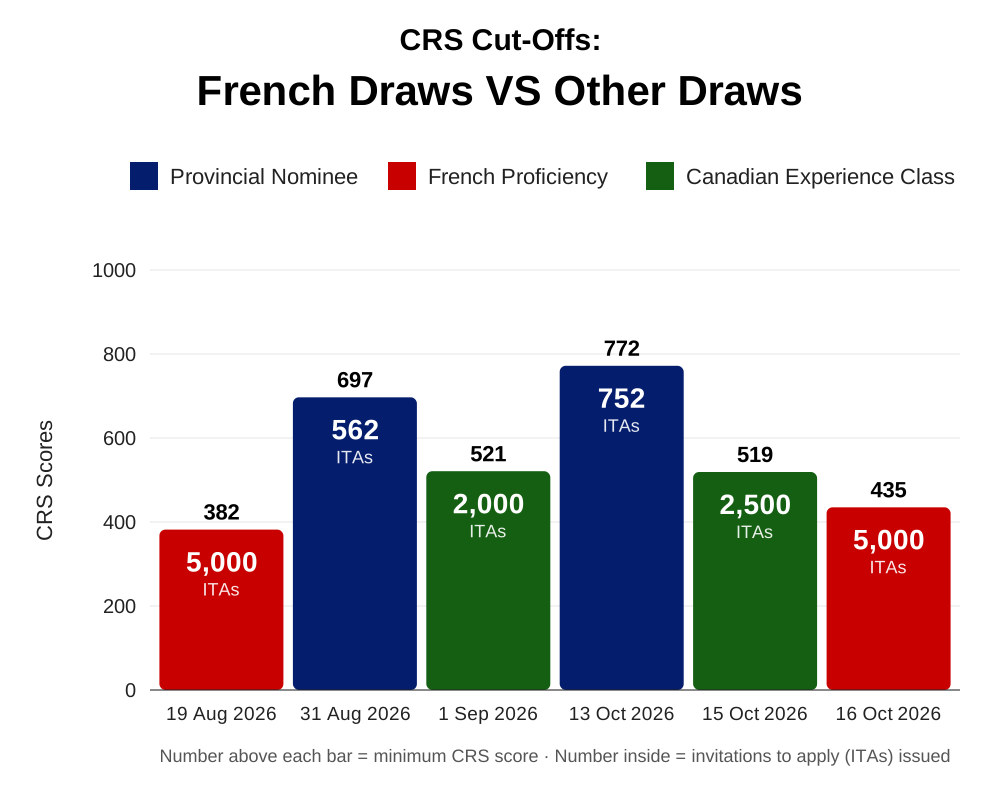
- French Proficiency draw cutoffs are significantly lower than All Program (General) draws (see the graph below)
- Consequently, French-speaking candidates, even with intermediate level (B2) French proficiency, have a tremendously higher chance of receiving invitations to apply for permanent residence than just English speakers
Earn Up to 74 Extra CRS Points with French + Become Eligible for French Stream Draws
- Under the Comprehensive Ranking System (CRS) for Express Entry, applicants can earn up to 74 extra points for French as a second language
- If you can demonstrate minimum CLB7 (B2) level proficiency via French exams, you earn 62 extra CRS points (50 bonus points plus 12 second-language points; 37 if your English is CLB 4 or lower) and you become eligible for special category French Proficiency Draws under Express Entry System
French & Canada Immigration: FAQs
How many CRS points does French give in Express Entry?
Scoring NCLC/CLB 7 or higher in all four French skills (speaking, listening, reading and writing) on an approved test such as TEF Canada or TCF Canada adds 50 bonus CRS points if your English is CLB 5 or higher in all four skills, or 25 points if your English is CLB 4 or lower or you did not take an English test. On top of that you earn regular second-language points for French: 1 point per skill at NCLC 5–6, 3 points per skill at NCLC 7–8 and 6 points per skill at NCLC 9 or higher. So CLB 7 in French is worth up to 62 points (50 + 12), and CLB 9 or higher up to 74 points (50 + 24).
What French level do I need for Express Entry?
CLB 7, which corresponds to B2 level in French, is the threshold that earns the extra CRS points and makes you eligible for French-proficiency draws.
What are French-proficiency draws, and why are their cut-offs lower?
Express Entry holds special category draws for candidates with French proficiency. Their minimum CRS cut-offs are significantly lower than the general (All Program) draws, so French-speaking candidates, even at intermediate B2 level, have a much higher chance of receiving an invitation to apply for permanent residence than English-only candidates. The chart on this page compares recent cut-offs.
Which exams prove my French level: TEF Canada or TCF Canada?
TEF Canada and TCF Canada are the French exams used to show your CLB level for Canadian immigration. BBarters prepares learners for both, with a TEF TCF Online French Program and separate TEF and TCF exam practice programs.
Can I reach B2 (CLB 7) starting from zero French?
Yes. The BBarters TEF TCF Online French Program is a 12-month, self-driven program that takes learners from beginner to B2+, with video lessons, quizzes, assignments, a monthly doubt-solving session, a CLB tracker and a full exam simulation.
Can I try the BBarters program before paying?
Yes. You can register for a free 3-day trial of the TEF TCF Online French Program. No payment or commitment is required.
Ready to start? Try the 3-day free trial or see the programs.